
Business Development for Professional Services Firms: Why It Sits With Two or Three People, and What That Costs You
In most New Zealand professional services firms, business development sits with two or three people. The partner who is good with clients. The director who seems to know everyone. The one who brings the work in. Everyone else delivers. That arrangement feels normal. It is also the ceiling on the firm’s revenue.

The constraint is not talent. It is that nobody has ever written the process down, and nobody owns the infrastructure that would let the whole team run it. This article sets out what concentrated business development costs a firm, why good intentions consistently fail to fix it, and what a structured alternative looks like in practice.
Why business development concentrates in two or three people
It persists because it works, right up until it doesn’t. A firm’s rainmakers built their networks over twenty or thirty years. They made the calls, sat on the boards, fronted up when nothing came of it, and kept going long enough that the phone started ringing back. What the firm sees is the outcome. What the firm concludes is that some people are simply wired for it. What actually happened is that a small number of people accumulated a set of habits over decades that nobody ever wrote down.
Rainmaking is a process, not a personality
That distinction matters, because it determines whether the capability can be extended to anyone else.

A personality cannot be transferred. A process can be taught, tracked and repeated. Every rainmaker in a professional services firm is running a process. They identify who is worth knowing. They work out what that person needs next. They do something about it. They do it again in a fortnight, whether or not the last attempt produced anything. The only unusual thing about them is that they have sustained it for decades without anyone reminding them to. Nothing in that list requires a particular temperament. All of it requires a cadence.
We’ve written separately about what that cadence looks like for an individual professional building a pipeline from scratch.
What concentrated business development costs: the arithmetic
Take a firm with twenty fee earners where business development sits with three of them. Those three are also delivering work, so realistically business development happens in the gaps: a burst of outreach before a quiet quarter, then nothing for six weeks when a deadline lands.
Now compare that with a firm of the same size running structured business development across all twenty people. In the Leads BD model, each participant commits to four to six business development actions every fortnight.
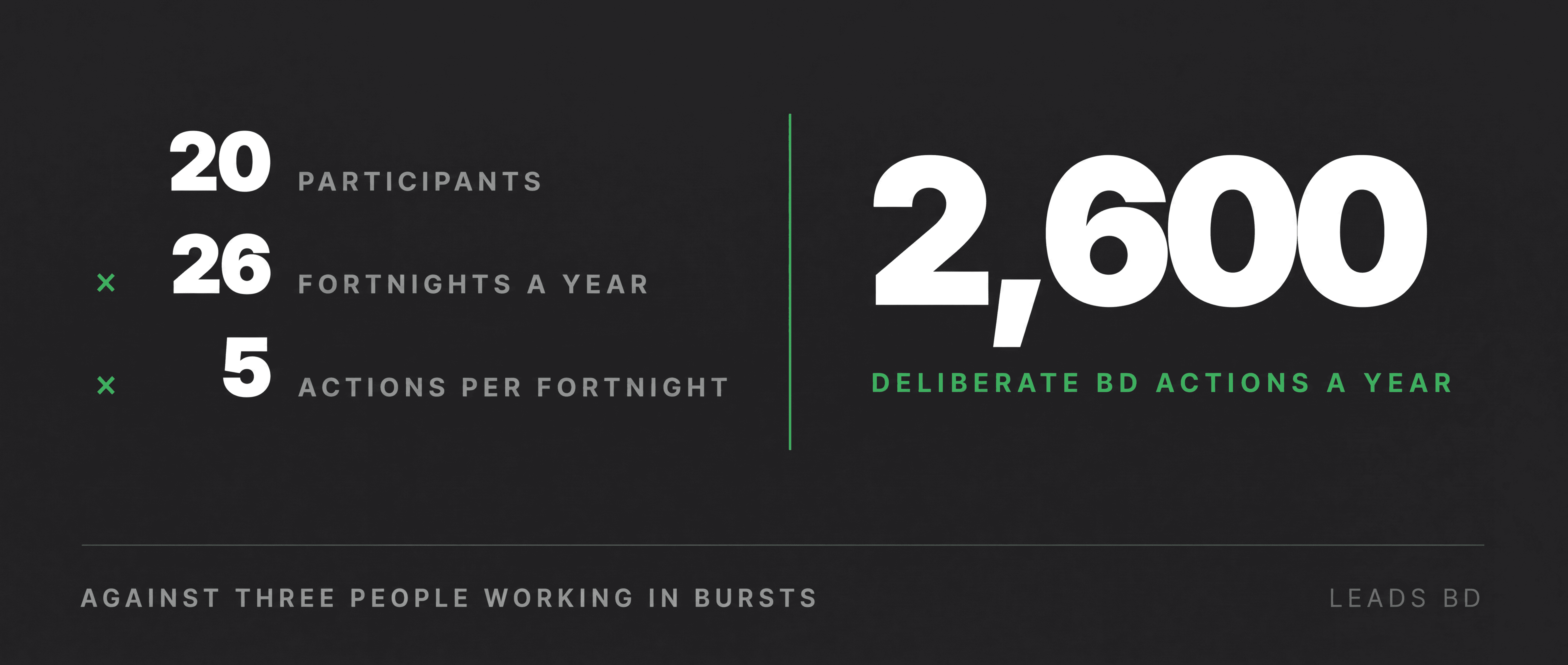
That is not a difference in effort or ability. It is a difference in whether the activity is structured.
The time it takes: 13 hours per person per year
Most firms assume structured business development will cost more time than they can spare. The arithmetic says otherwise.
One structured session, thirty minutes, once a fortnight. Twenty-six sessions across a full year is 13 hours per person. For a fee earner billing 1,500 hours, that is under 1 percent of their year — spent on the activity that determines whether the other 99 percent has anything to work on.

Why firms already know this and still don’t do it
Here is the honest part: most firms have already had this conversation. They have agreed that everyone should be doing more business development. Some have run a workshop about it.
Then a major project lands, and the business development action is the first thing to fall away. No one notices when someone skips a week, then two, then a month. By the quarter’s end the initiative has quietly stopped, and nobody can point to the moment it did.
Intent is not the missing piece. Infrastructure is.
The reason firms cannot build that infrastructure internally is not technical difficulty. It is ownership. Inside a firm, business development discipline is always someone’s third priority, behind their own client work and their own deadlines. There is no one whose actual job is to notice that a prospect has gone quiet.
How the Lead Facilitation Programme works
The Lead Facilitation Programme has three parts, and they only work together.
1. Facilitation
A structured thirty-minute session with each participant every fortnight. It follows the same shape every time:
Review the tasks set last fortnight
Confirm what else happened
Add new prospects
Work out what each prospect needs next
Assign four to six actions for the fortnight ahead
Each session closes with a written summary in the participant’s inbox.
It is not a pep talk. It is the same conversation on the same cadence with someone whose job it is to notice.
2. Data
Every prospect and every business development action is recorded. Not for the sake of administration, but because it is the only way to benchmark the team against itself over time. Without a record, “we should all be doing more business development” stays an opinion.
3. Reporting
The quarterly report turns recorded behaviour into something a firm can manage. It measures:
Which business development actions convert, and which do not
How long it takes to move from first contact to a secured meeting
How often meetings become real opportunities
Where targets are lost, and why

The reporting layer also catches drift on its own, without anyone having to remember to check. Forty working days without a business development action on a prospect triggers a review. Sixty working days triggers reactivation.
What changes, and why it compounds
Rainmaker dependency drops. Business development capability becomes distributed and visible instead of concentrated and invisible. The firm’s revenue pipeline no longer rests on two people and their contact lists.
Rising people become identifiable. The quarterly report shows who is actually generating activity, which turns promotion conversations from impressions into evidence.
Business development stops being an initiative. It becomes the cadence the firm runs on — the thing that continues through a busy quarter rather than the thing a busy quarter displaces.

Frequently asked questions
How much time does structured business development take per person?
Thirty minutes per fortnight, or 13 hours across a full year. For a fee earner billing 1,500 hours, that is under 1 percent of their billable year.
How is this different from business development training?
Training transfers knowledge and then ends. The Lead Facilitation Programme is a recurring cadence with a facilitator, a data record and quarterly reporting. Most firms do not fail at business development because their people lack knowledge; they fail because nothing in the structure notices when the activity stops.
Why can’t a firm run this internally?
It can, technically. In practice, business development discipline inside a firm is always someone’s third priority behind their own client work. The programme works because the person running it has no competing deadline.
What does the quarterly report actually measure?
Conversion rates by action type, time from first contact to secured meeting, the rate at which meetings become genuine opportunities, and the reasons targets are lost. It also flags prospects with no activity for 40 working days and escalates at 60.
Get in touch
Business development should not depend on two people and their goodwill. If you would like to see what structured business development could look like across your firm, get in touch with Leads BD.
Leads BD: business development made simple.