
Business Development for the Rest of Us: How to Build a Revenue Pipeline in Six Months (Without Screwing Up Your Real Job)
If your job title has absolutely nothing to do with sales, but growing the business has quietly become part of your responsibility anyway, take a deep breath. You are not alone, and you are definitely not doing it wrong.
Most business development (BD) advice out there is written for full-time sales reps. It just doesn’t translate to engineers, consultants, project leads, or technical experts who are expected to bring in revenue while also delivering heavy client workloads. For us, BD usually feels like an afterthought, that nagging task on the to-do list we promise to get to once the real work is done.
Spoiler alert: it rarely happens.
This is about what actually works when BD is your secondary responsibility, not your full-time gig. No awkward cold calling. No burning cash on marketing campaigns. Just a simple, repeatable system that quietly builds momentum over six months.
Why Most BD Efforts Fizzle Out
The honest truth? It’s not a lack of talent, a bad network, or even a lack of time (though time is always the easiest thing to blame). The real culprit is the lack of a realistic system.
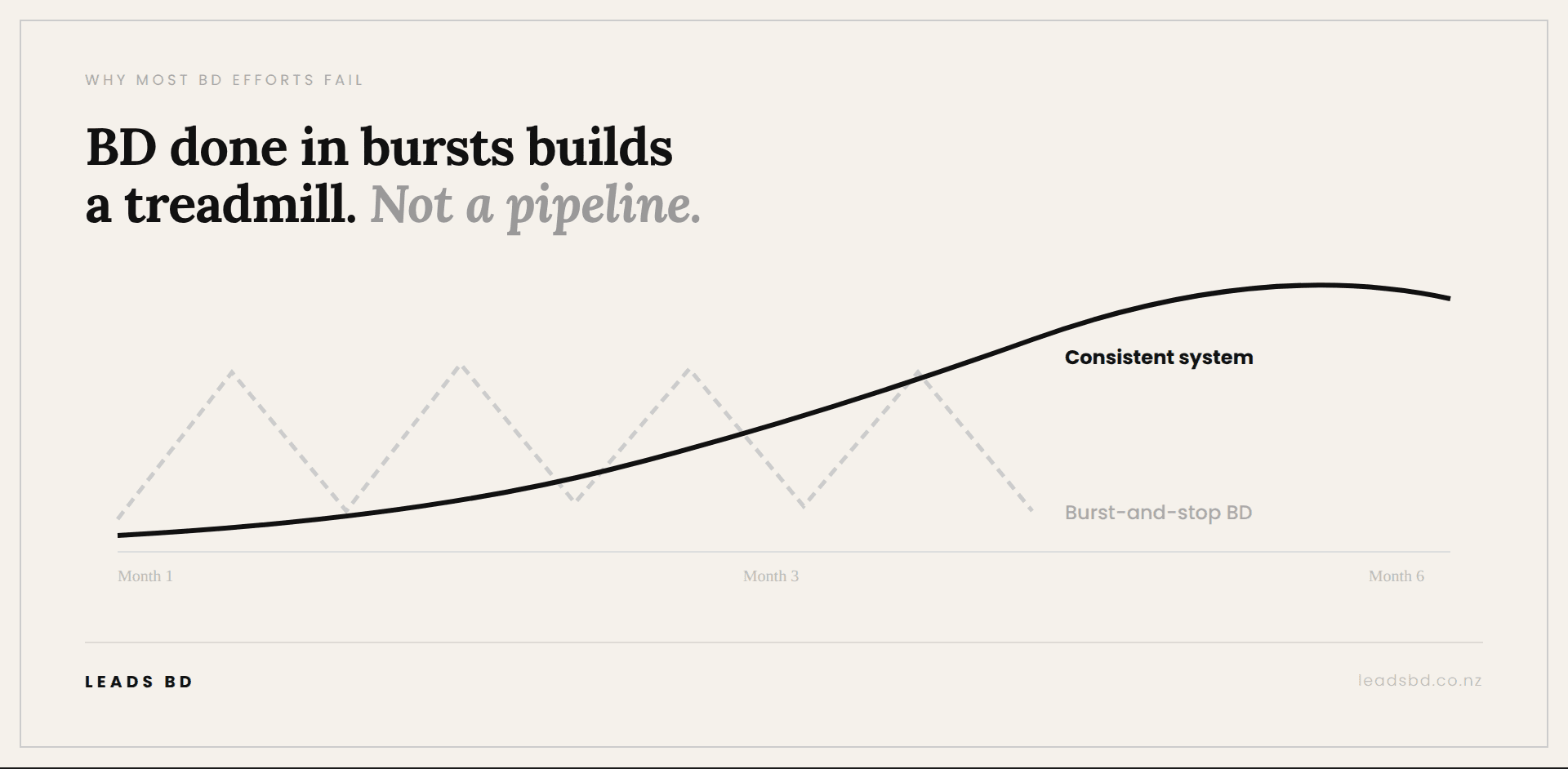
We’ve all seen, or lived, this cycle: you decide it’s time to be proactive about bringing in work. You commit to a massive burst of energy. You book coffees, send a flurry of LinkedIn messages, and schedule catch-ups. Then, two weeks in, a massive project deadline hits. BD stops dead in its tracks. A month later, things quiet down, and you try to jump-start it again.
Stop. Start. Stop. Start.
Your pipeline never builds momentum because the effort isn’t sustained long enough to compound. Doing BD in bursts doesn’t build a business; it just keeps you on a treadmill. The only way out is to treat BD as a tiny, non-negotiable habit maintained regardless of your workload, rather than a massive project you only launch when you have spare capacity.
Step 1: Map Your Existing Network (It’s Bigger Than You Think)
Most professionals wildly underestimate how many warm relationships they already have. Your network isn’t just your current clients. It includes former clients who loved working with you, industry partners, old colleagues, and people who reached out months ago but slipped through the cracks.
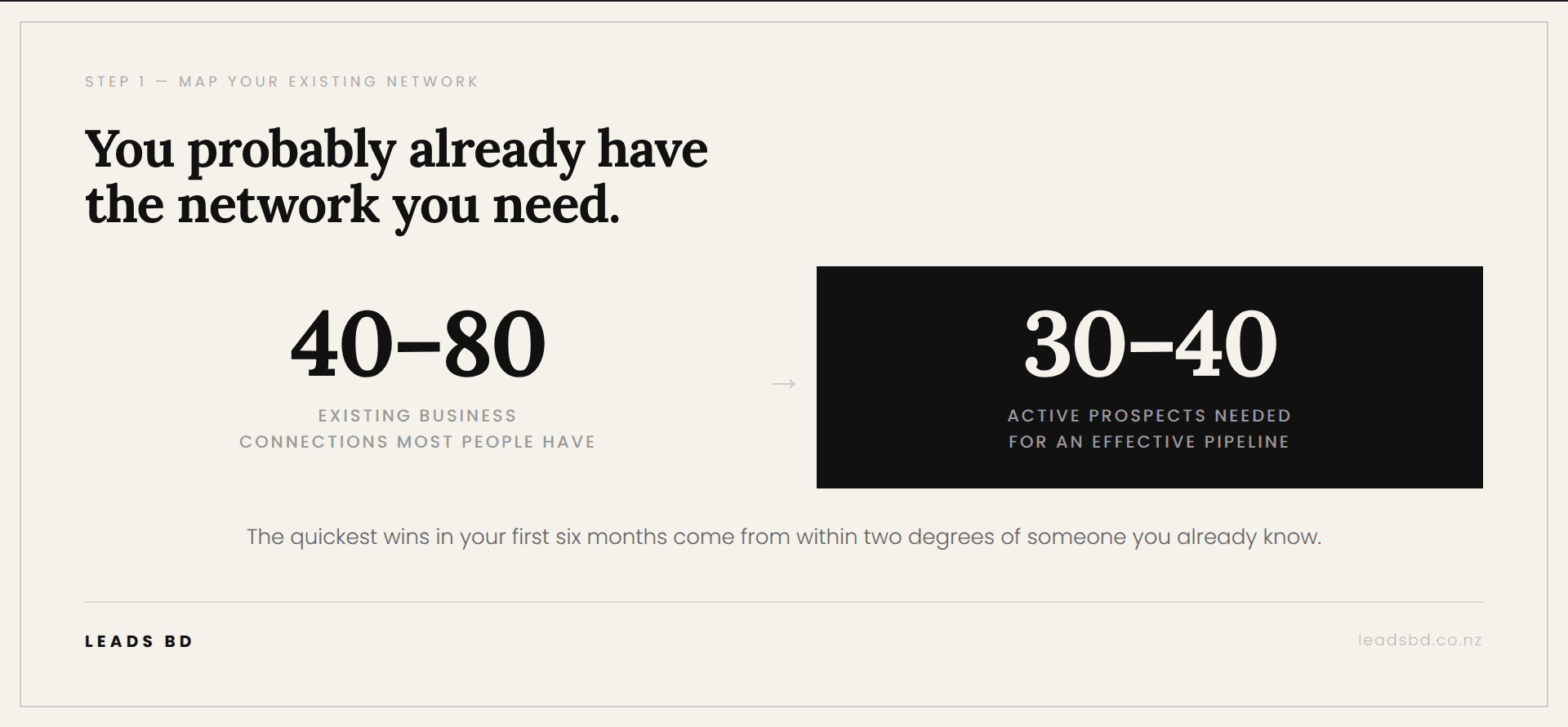
Sit down and write them all down. Realistically, most people have between 40 and 80 solid connections already sitting there. Here’s the reassuring part: to run an effective pipeline, you only need about 30 to 40 active prospects at any given time. You likely already have your target list waiting in your contacts.
Re-engaging someone who already knows and trusts you takes a fraction of the energy required to pitch a stranger. Your quickest wins in the first six months will almost always come from within two degrees of your existing network. Start there before you look anywhere else.
Step 2: Expand Through Warm Introductions
Once you’ve mapped your network, you can start looking for new targets, but always through connection, never cold contact.
In high-ticket professional services, cold outreach hits a hard ceiling. The market is tight, relationships take time to mature, and decision-makers have excellent filters for generic pitches. What actually works is the warm referral.
Look at your mapped network and think about who they know that you’d love to meet. Connect the dots back to your existing relationships wherever possible. Even a casual second-degree introduction is worth infinitely more than a cold name on a spreadsheet.
Step 3: The “Two Actions Per Week” Rule
This is where people usually overcomplicate things, obsessing over the perfect message, the perfect timing, or the perfect excuse to reach out.
Forget perfect. Consistency is what matters.
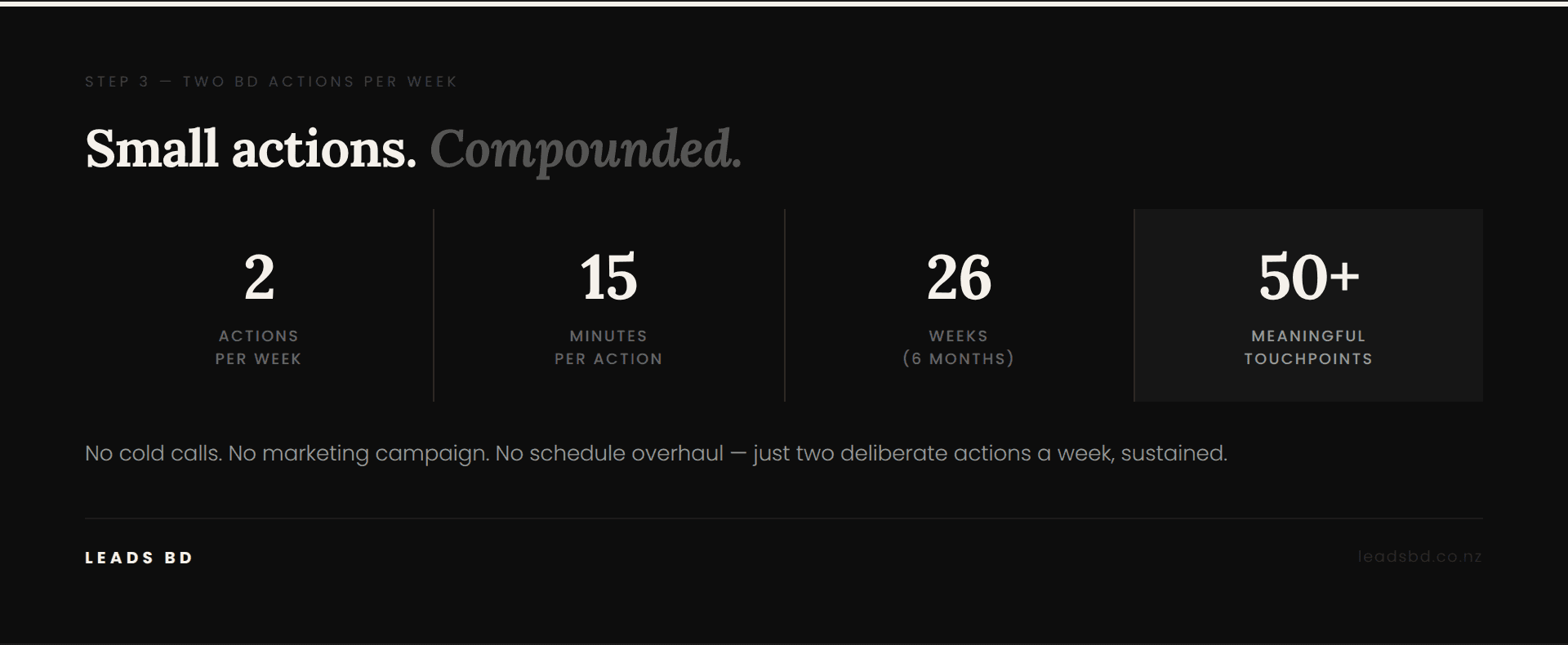
The rule is incredibly simple: two BD actions per week, taking up roughly 15 minutes of focused effort. That’s the whole commitment.
An action could be sending a quick text to a former client to see how their new project is going. It could be dropping a LinkedIn message to a contact you haven’t spoken to in a year. You might introduce two people in your network who would genuinely benefit from knowing each other, or share an article, a piece of news, or an event that is actually relevant to a prospect’s current challenges.
None of these take more than a few minutes, but all of them move a relationship forward. Two actions a week, sustained over six months, adds up to over 50 meaningful touchpoints, all without a single cold call. The goal isn’t to close a deal on the spot; it’s to stay top-of-mind and be helpful so that when they do need help, you’re the first person they call.
Step 4: Relationship First, Always
This is what separates professionals who build lasting pipelines from those who get stuck starting over every quarter.
In our world, trust is everything. Nobody hands an expensive contract to a firm, or a person, they don’t completely trust. That trust is built incrementally: by showing up consistently, demonstrating real expertise, and being genuinely interested in their challenges rather than your own sales targets.
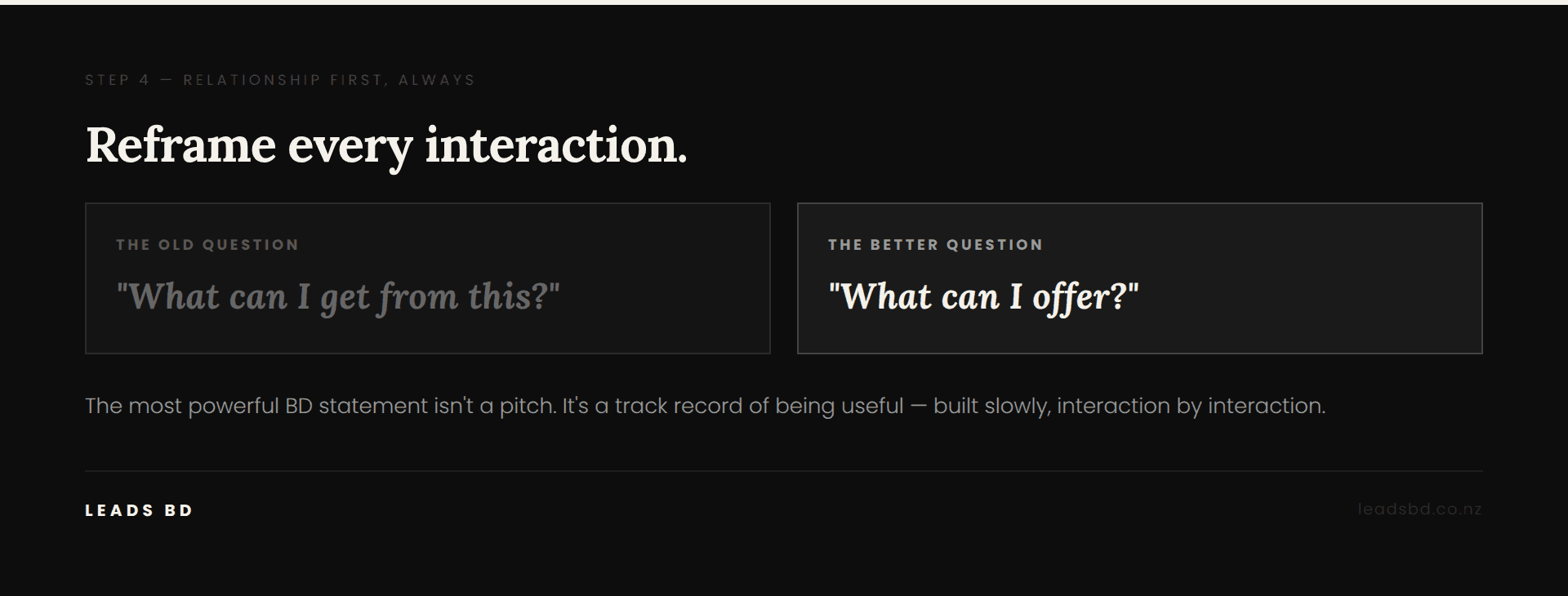
Shift your mindset from “what can I get out of this person?” to “how can I be useful to them?” Your track record and reputation matter, but your genuine willingness to help in the moment matters just as much. The most powerful business development strategy isn’t a slick pitch; it’s a reputation for being incredibly helpful, built slowly, one conversation at a time.
The Catch
The framework itself is easy. Stick with it consistently for six months? That’s the hard part.
The second a major project lands or a fire needs putting out, BD is the first thing we drop. Not because it isn’t important, but because there’s no external structure keeping us on track. No accountability. No system. Nobody notices if you skip a week, then two weeks, then a month.
This is exactly why most BD initiatives inside busy firms fail. It’s not a lack of capability, it’s just that maintaining consistency on top of your day job is genuinely tough without a bit of backup.
That’s the specific gap we built Leads BD to fix. Our Facilitation Programme works with busy professionals one-on-one, every fortnight, to build and protect the habits that drive revenue growth over time. We provide the structure, the simple tracking tools, and the friendly accountability you need to turn good intentions into an active, functioning pipeline.
The process absolutely works. The real question is: do you have the system in place to stick with it long enough to see the results?
If you’re reading this as a firm owner rather than an individual, we’ve written a companion piece on why business development in most professional services firms sits with two or three people and what that costs.