
Why Traditional Sales Tactics Fail in Professional Services (And How Modern Business Development Changes the Game)
In professional services, there is a pervasive hesitation around the word "sales."
Partners, directors, and technical experts have spent decades mastering their craft—whether in engineering, law, architecture, accounting, or specialist consultancy. When asked to drive firm growth, the immediate image that surfaces is often high-pressure prospecting, aggressive closing scripts, and transactional sales funnels.
The natural reaction is resistance. And rightly so: what works in volume B2B sales does not translate to high-trust professional markets.
In relationship-driven industries across New Zealand and the wider Australasian market, growth doesn't come from aggressive pitch decks. It comes from systematic business development—leveraging technical credibility, building long-term goodwill, and turning quiet seasons into pipeline-building engines.
If your firm wants to increase revenue, broaden the pipeline beyond a single rainmaker, and build a sustainable client acquisition engine, you don't need a conventional sales script. You need an intentional business development programme designed specifically for high-trust environments.
Here is why traditional sales assumptions fall flat—and how partnering with the right business development consultant transforms commercial capability across your firm.
1. The Myth of the "Salesperson": Lead with Credibility, Not a Persona
The single greatest bottleneck to growth in professional practices is the belief that business development requires an extroverted, high-pressure persona.
In transaction-led sales, volume outreach and standard pitches might convert a small percentage of cold prospects. But in professional services—where project values are substantial, delivery timelines span months or years, and client risk is high—buyers select partners based on trust, competence, and relationship equity.
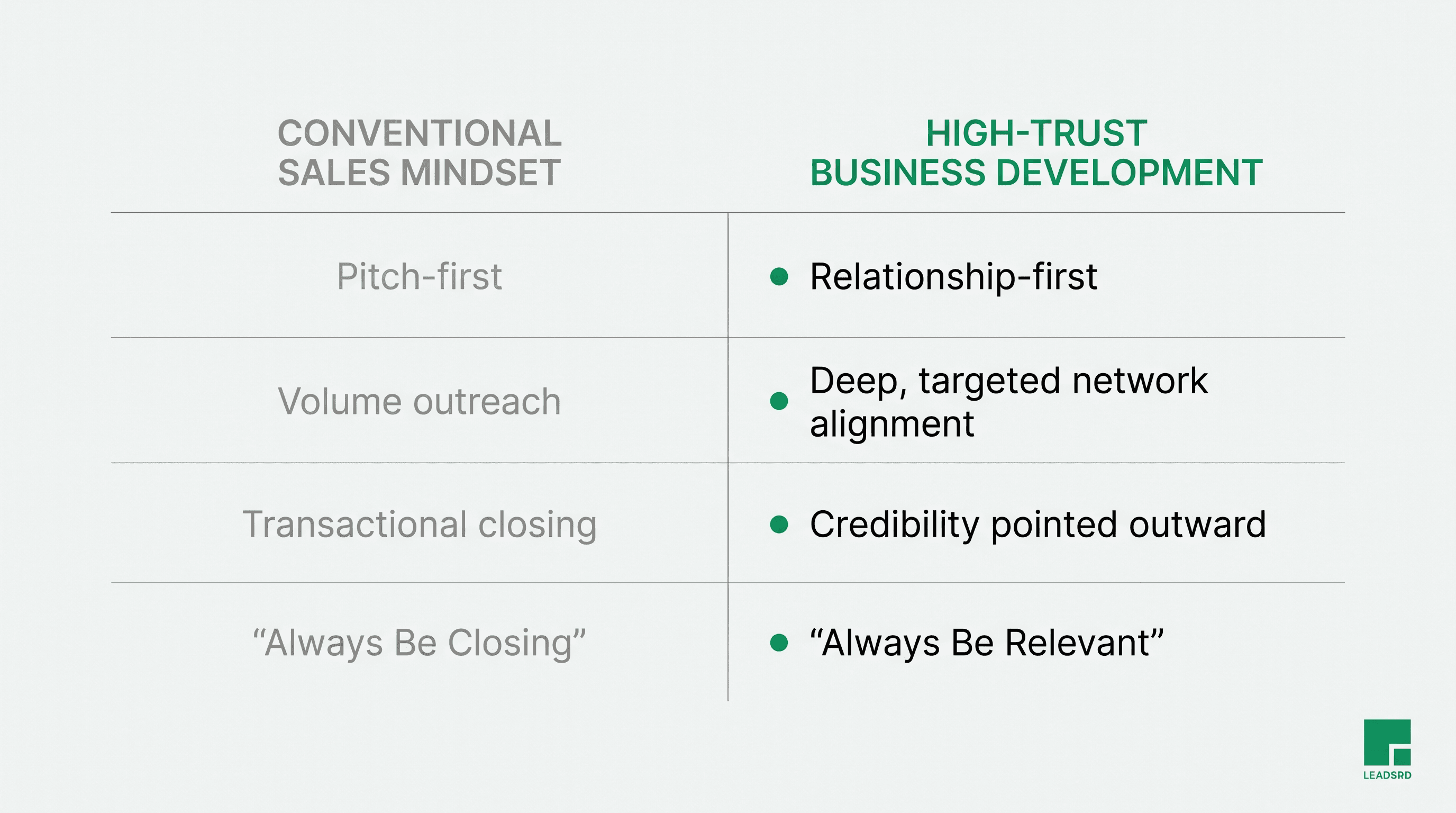
Effective business development training teaches senior professionals that BD is not a personality you switch on. It is the deep technical credibility they already bring to their daily work, strategically directed outward.
When your team realises that BD is simply an extension of client care and expert problem-solving, the mental barrier disappears.
2. The Quiet Season Strategy: Why Repeat Business Demands Consistent BD
A common trap for consulting and engineering firms is treating client outreach as an emergency response to a thinning pipeline. When work is quiet or a major tender drops, firms scramble to reconnect.
Clients immediately detect this pattern. It signals that contact is conditional on immediate financial gain, reducing a professional relationship to a transactional exchange.
The Lifetime Value Principle
In B2B advisory and professional services, repeat business correlates directly with the duration and consistency of the relationship. Converting repeat commissions is the result of months—and often years—of consistent, low-friction touchpoints.
A structured business development programme establishes systems for proactive client nurturing:
The "Zero-Agenda" Check-In: Engaging past and existing clients when nothing is on the table builds long-term goodwill.
Proactive Market Insights: Sharing regulatory updates, sector trends, or technical insights with zero expectation of an immediate commission.
Relationship Continuity: Maintaining top-of-mind awareness across key stakeholders so that when a project is scoped, your firm is the only logical choice.
The firm that consistently engages during quiet stages is the firm that gets shortlisted without having to compete in open tenders.
3. Depth Over Volume: Why 5 Strategic Conversations Beat 1,000 Cold Emails
The rise of automated sales outreach tools has led many firms to deploy generic email sequences and cold LinkedIn automation. While cold outreach is staple sales strategy for low-ticket software products, it carries significant brand risk in specialized professional markets.
A generic cold email broadcasted across regional markets (whether targeting Auckland property developers, Wellington government agencies, or regional infrastructure boards) signals a lack of market understanding.
In high-value business development, depth always outperforms volume:
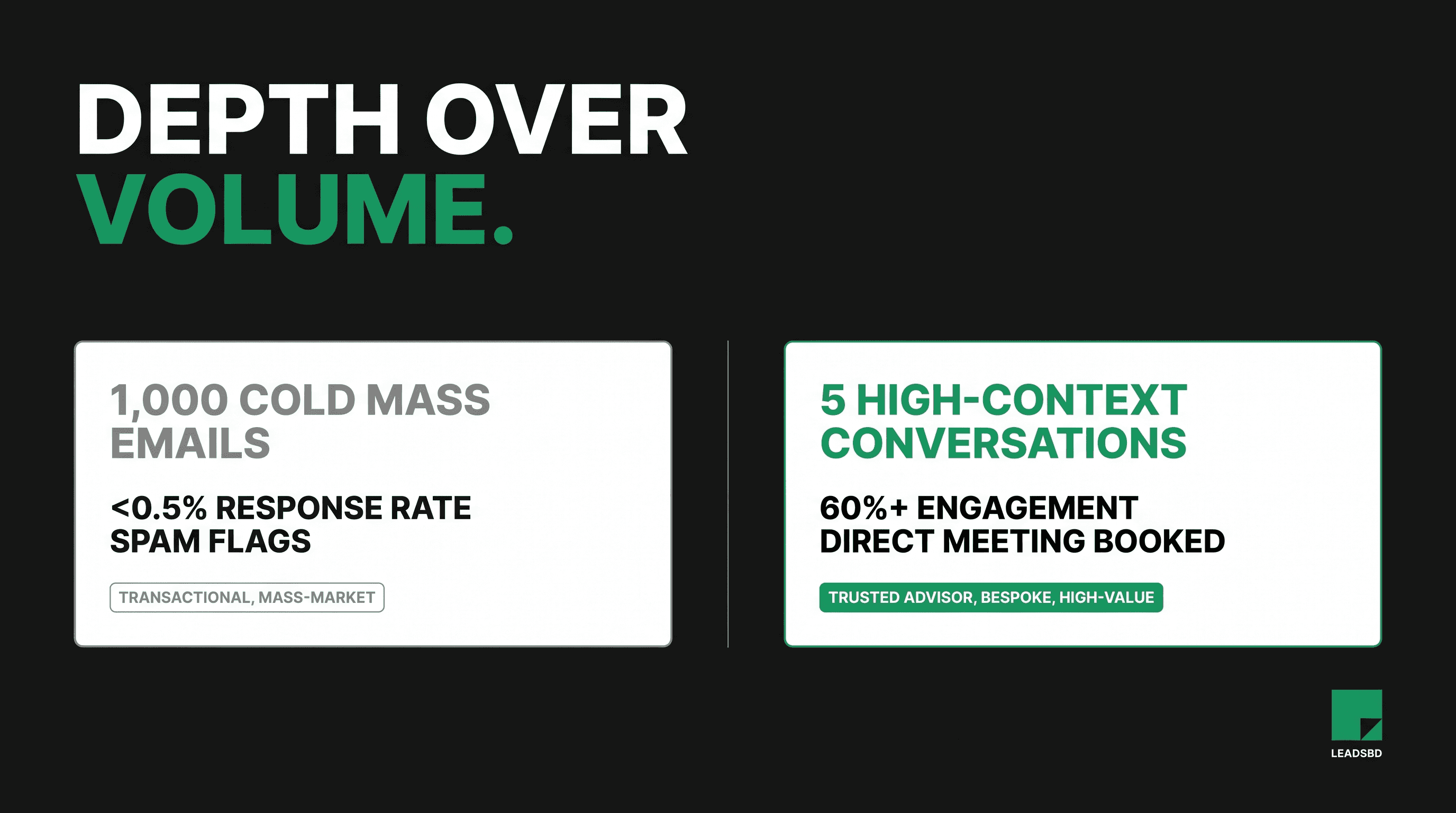
True business development focuses on five high-touch calls, five coffee meetings, or five personalised communications that could only have been written by your expert for that specific client. Activity should never be confused with achievement.
4. The Merit-Based Advantage: You Don’t Need Natural Charisma to Win Work
Firm leaders often assume their best business developers will be the most extroverted individuals in the office. In practice, the opposite is frequently true.
The professionals with the strongest, most resilient commercial networks are often those who are simply exceptional at delivery. Their network is built on a track record of reliability, sound judgment, and technical excellence.
Every senior practitioner already has an embedded network:
Past Clients: Decision-makers who have experienced your delivery firsthand.
Affiliates & Sub-consultants: Peer firms that require complementary capability.
Industry Referrers: Professionals who encounter opportunities outside their immediate scope.
A dedicated business development consultant works with delivery teams to systematically map, activate, and nurture these existing degrees of connection. Because these relationships are founded on proven merit rather than salesmanship, they convert into pipeline opportunities with substantially higher win rates.
5. Moving Beyond "Fuzzy" KPIs: How to Measure and Scale BD ROI
One of the main reasons managing partners hesitate to invest in business development training is the perception that BD is too vague to quantify compared to traditional sales operations.
Sales environments track conversion rates and close dates. In professional services, standard conversion metrics miss the early indicators of pipeline health.
The single most valuable leading metric in professional services BD is Opportunity Creation.
Why Opportunity Creation Is the Key Metric
Opportunities generated through genuine relationships carry fundamentally different characteristics than inbound leads from advertising:
Higher average contract value
Lower price sensitivity (less fee discounting)
Significantly reduced competitive pressure
Shorter final procurement cycles
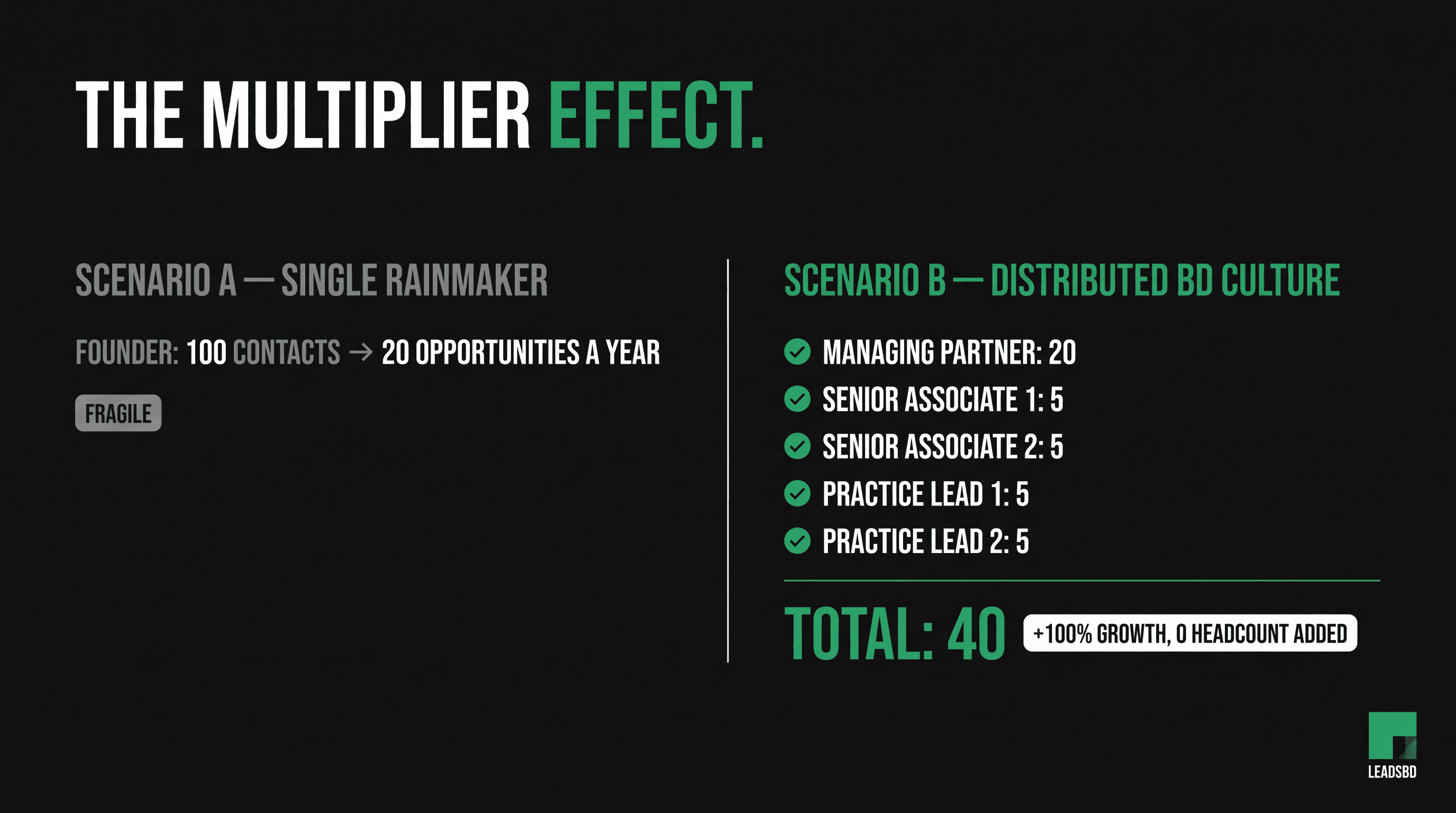
The Multiplier Effect: Transforming Firm Economics
Consider the compounding impact of shifting from a single rainmaker to an active BD culture across your senior bench:By empowering four senior team members to generate just five qualified opportunities per year, the firm doubles its BD pipeline. This growth requires no massive recruitment costs and no six-figure ad budgets—just a structured cultural and operational shift.
What to Look for in a Business Development Consultant & Training Partner
When selecting a business development programme for your firm, standard sales courses built for transactional products will encounter immediate resistance from technical staff.
Look for a training framework that prioritises:
Sector Alignment: Deep familiarity with high-trust, fee-for-service environments (legal, architectural, engineering, advisory).
Opportunity-Led Methodology: Focus on network mapping, client engagement cadences, and relationship compounding rather than closing scripts.
Culture-First Implementation: Practical workflows that allow busy practitioners to integrate BD into 2–3 hours per week without compromising project billables.
Accountability & Systems: Clear frameworks for tracking opportunity generation, referral pipelines, and institutional relationship data.
Build a Predictable, Multi-Rainmaker Pipeline
Scaling a professional services firm does not mean compromising your standards or turning your team into salespeople. It means giving your experts the framework, clarity, and confidence to represent their value in the market.
At Leads BD, we design and deliver tailored business development training and advisory programmes that help professional services firms shift from founder-dependent revenue to a scalable, distributed BD culture.
Ready to institutionalize business development across your firm?
Explore our Business Development Programmes or Book a Strategic Consultation to discuss your practice's growth objectives.
Frequently Asked Questions (FAQ)
What is the difference between sales and business development in professional services?
While sales typically focuses on converting active, qualified pipeline into closed contracts through negotiation and commercial terms, business development is the upstream discipline of creating relationships, identifying market opportunities, and positioning the firm long before a tender or RFP is issued.
How does a business development programme help technical professionals who dislike selling?
A specialised business development programme reframes client acquisition around advisory value and technical credibility. Rather than teaching aggressive sales tactics, it provides frameworks for peer-to-peer networking, active listening, client relationship mapping, and value-led check-ins that feel natural to delivery experts.
How long does it take to see ROI from business development training?
Because professional services procurement cycles often span 3 to 12 months, the leading indicator of success is opportunity creation within the first 60–90 days. As senior practitioners activate latent networks and implement proactive check-in cadences, qualified pipeline volume typically doubles within 6 to 12 months.